Whom Do We Thank for Women’s Conferences?
Here
in this truly
no man’s land,
all is fair as understood not in terms of
Penelope’s false blondness but
that which is right and healthy.
Where
we throw
our big
hairy legs and
bottoms that make any Levi’s cry for air.
Hairy too are the faces
we acknowledge
—some were born that way—or
as signs of:
the pills we took in,
the wombs we threw out, and
plain
normal
aging.
Yet
ancient graces
walk elegantly tall or
charmingly petite
in celebration pinks and royal indigos . . .
as though the earth itself was
newly found,
the air a discovery.
We were not afraid of ideas.
Not our own.
Not those of others.
Along those corridors and
in those easy days’ assemblies,
apologizing for our being was
not on.
We were
Nobody’s wives or mistresses.
No one called us
“Mother”:
and when some daughters present did,
it was with the clearest mandate that
they picked the fight where we brought it.
We were
only ourselves:
each alone as when we were born, and
shall be, when
we died.
But
living and together,
a true power thing that
searches
researches
solving
resolving . . .
And as always
sweetly hopeful as
only women can be.
Quote: “African women were feminists long before feminism. They had to be.”
— Ama Ata Aidoo
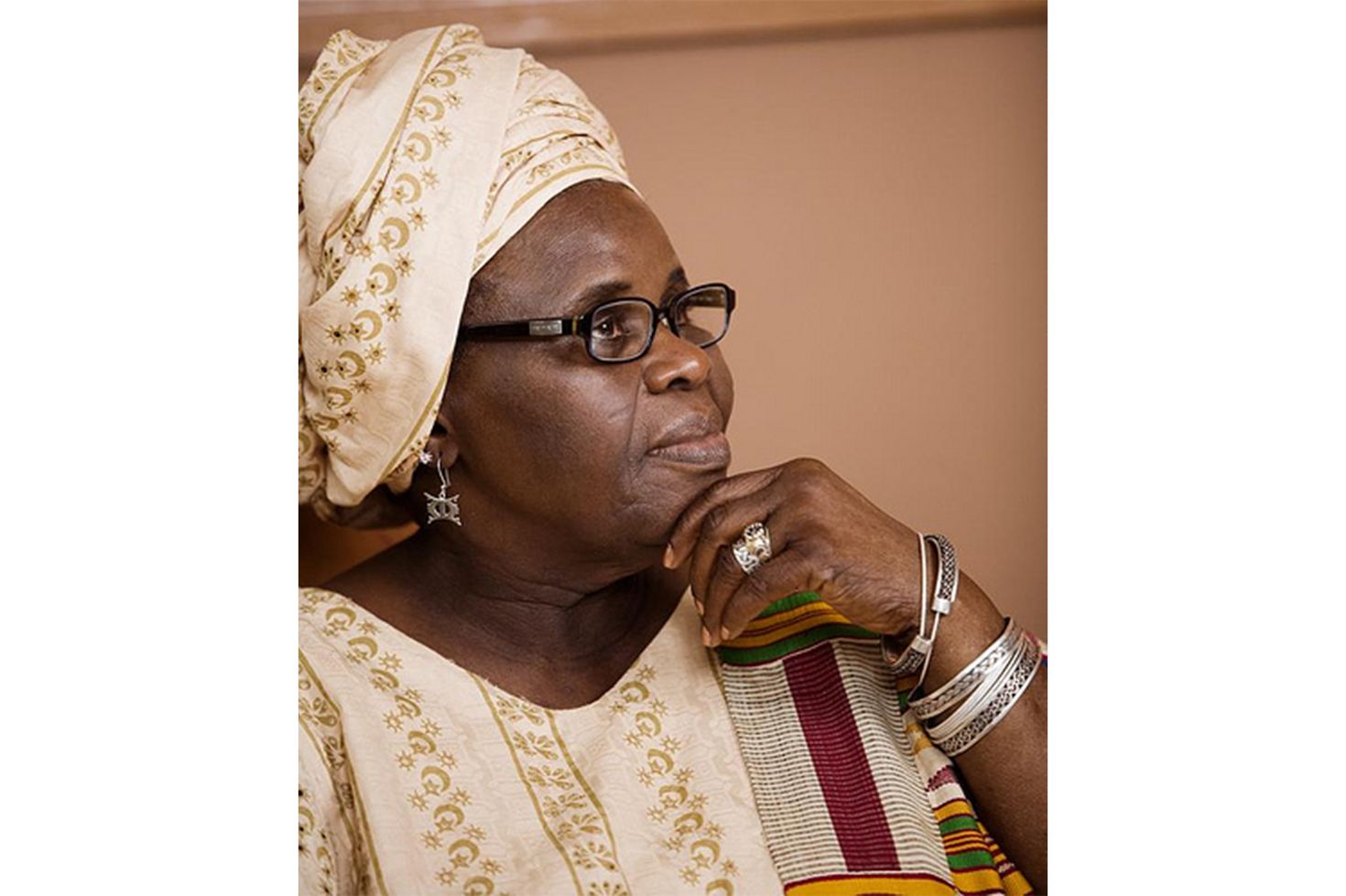
Ama Ata Aidoo was a Ghanaian writer, politician, and academic whose work problematized the paradoxes of modern African identity, particularly for women. She served as Ghana’s Minister of Education from 1982 to 1983. Her work includes the play The Dilemma of a Ghost (Longman, 1965), which made her the first published female African dramatist; the novel Our Sister Killjoy; or, Reflections from a Black-Eyed Squint (Longman, 1966); the short story collection No Sweetness Here (Longman, 1970); and the poetry collection Someone Talking to Sometime (College Press, 1985). Aidoo earned a BA from the University of Ghana in 1964. She taught as a professor in Ghana, Kenya, and the United States.
Resources https://www.poetryfoundation.org/poets/ama-ata-aidoo
African Feminism vs. Western Feminism
Aidoo’s feminism was distinctly African. She rejected the idea that gender equality could be discussed apart from history, economics, and colonialism. In her view, feminism in Africa could not simply replicate Western models focused on individual liberation or legal equality. It had to address the communal structures, cultural continuity, and the intersection of patriarchy with imperialism that produced inequality.
Her characters are not merely fighting men; they are negotiating complex worlds shaped by colonial education, class and tradition. They challenge the notion that progress means rejecting culture. Instead, Aidoo’s women seek to redefine it. Her feminism emphasizes cooperation, storytelling, and cultural reclamation over confrontation, a framework many scholars now recognize as central to African feminist thought. Aidoo remarked in her 1998 essay “The African Woman Today” that she is a feminist, insisting that “every woman and every man should be a feminist.”
Beyond the Page: Educator, Activist, and Advocate
Aidoo’s activism extended beyond writing. In 1982, she was appointed Ghana’s Secretary for Education under Jerry Rawlings’ government, the first woman to hold the post. She resigned a year later as she was frustrated by the political constraints that prevented her from implementing changes. She later worked in Zimbabwe with the Ministry of Education’s Curriculum Development Unit and was active in the Zimbabwe Women Writers Group. In 2000, she co-founded the Mbaasem Foundation with her daughter Kinna Likimani, a nonprofit organization supporting Ghanaian and African women writers. Through education, mentorship, and advocacy, she advanced the cultural infrastructure necessary for African women’s literary production, a vision of feminism that was as practical as it was philosophical.
Resource: https://www.blackwomenradicals.com/blog-feed/the-radical-feminist-imagination-of-ama-ata-aidoo
~Nikki
 Nikki's Confetti Life
Leave a comment